

US Taxes for Expats: 7 Lessons learned
Back home in the Netherlands, filing taxes meant logging in, clicking ‘agree’ three times and being done before my coffee went cold. In America? Let’s just say my coffee went cold several times.
Our first year in Houston we were lucky: the tax return was handled through my husband’s employer. We handed over some paperwork and someone else did the rest. Lovely. Then my husband changed jobs, and this year we suddenly had to do it ourselves.
In this post I share what we learned about filing US taxes as an expat, what I will do differently next time and how we finally got it done. Including a free expat tax checklist you can download.
My biggest lesson: it is a lot, and nobody tells you how it works
If I had to pick one thing, it is this: I underestimated how complex it is. How much time it takes to check everything. How quickly you forget something. And how long it takes before you even understand the process.
In the Netherlands the tax office fills in almost everything for you. You file, you get an assessment and you pay afterwards. In the US there is no clear letter telling you what to do, where to pay or roughly how much it will be. You have to work out what you owe yourself and pay it before the deadline, even if your return is not finished yet.
On top of that, the US taxes your worldwide income. You think you closed the chapter on your home country, but your foreign bank account, your house and last year’s bonus all travel with you.
7 lessons from our first year of filing US taxes as expats
1. Start on January 1, not in March
The deadline is April 15, but start in January. We filled in a long questionnaire first and thought: done. It turned out to be only the beginning. I spent hours on it: adding, correcting and then realizing at ten at night that something was still missing.
That questionnaire alone was quite a job, with everything you had to collect and figure out. One example: I thought the annual statement from our Dutch bank would be enough. It was not. They want the highest balance during the year, not the balance at the start and the end. And the savings account? You simply add that on top.
What helps most is keeping track all year long:
- Travel days outside the US, with dates
- Every bonus or extra payment: date, amount and what was withheld
- The highest balance of each foreign account
- Rental income and all costs of your house, with receipts
- Childcare costs
- Tax you paid in another country
- Big changes: new job, move, new baby
One folder, digital or paper, and everything goes in the moment it arrives.
2. Pay on time, or you pay interest
Can’t finish your return before April 15? You can request an extension until October 15. Be careful: that is an extension to file, not to pay. What you owe has to be paid by April 15.
If you pay too little or too late, you pay interest on the difference. That rate is currently 7% per year and is set again every quarter (IRS). On top of that there is usually a late payment penalty of 0.5% per month on the unpaid amount.
The hard part: you have to estimate what you owe yourself. This is how we did it:
- Add up your total US income for the year (look at year to date on your last pay stub).
- Use the tax brackets below to work out roughly what you owe.
- Check on that same pay stub how much federal tax has already been withheld.
- The difference is what you still have to pay, or get back.
In doubt? Pay a little too much. You get it back.
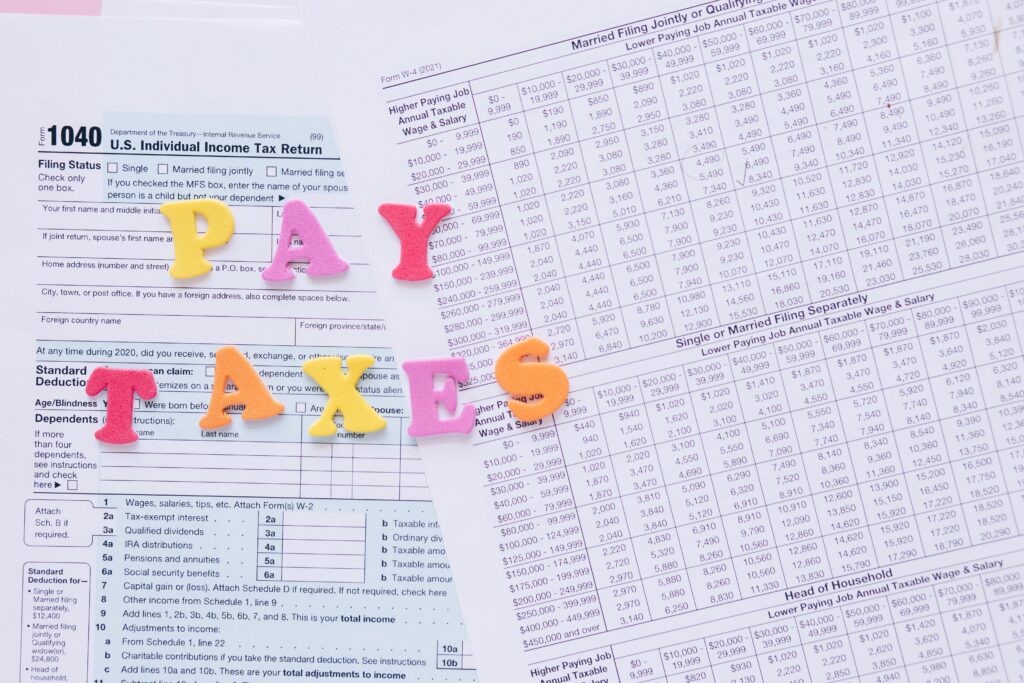
3. Look up the current tax brackets and use your total annual income
The US has seven federal tax brackets. The amounts change every year, so always look up the current ones for your filing status. As a married couple you usually file together (married filing jointly). These are the brackets for tax year 2026:
| Rate | Taxable income (married filing jointly, 2026) |
|---|---|
| 10% | up to $24,800 |
| 12% | $24,800 to $100,800 |
| 22% | $100,800 to $211,400 |
| 24% | $211,400 to $403,550 |
| 32% | $403,550 to $512,450 |
| 35% | $512,450 to $768,700 |
| 37% | over $768,700 |
Two things to know. Each rate only applies to the part of your income that falls in that bracket. And it is about taxable income: the standard deduction comes off first ($32,200 for a married couple in 2026).
Look at your total income for the whole year, not one month. We only used our pay stubs and that already gave a good picture. Nice detail in Texas: there is no state income tax here. In many other states it comes on top.
4. Big bonus? Expect to pay extra
This was our most expensive lesson. A flat percentage is withheld from a bonus (usually 22% federal). If your total income puts you in a higher bracket, too little has been withheld. You pay the difference when you file.
Set part of every bonus aside, or adjust your withholding through your employer (Form W-4).
5. You can fix a mistake, but it can cost money
Forgot something, or a document arrived late? You can file a corrected return afterwards (an amended return, Form 1040-X). It does not have to be perfect in one go.
Does it cost money? That depends:
- Filing the correction is free at the IRS. Your tax preparer will usually charge a fee.
- Do you owe more? Then you pay interest from the original deadline, not from the day you found the mistake. The faster you correct, the less interest.
- Waiting too long to pay? A penalty of 0.5% per month is added. For large errors the IRS can add an extra 20% penalty.
- Getting money back? Then it costs you nothing. You usually have three years to claim it.
In short: correcting is not a disaster, waiting is expensive.
6. Your house abroad counts as income
Renting out your house in your home country while you live here? That rental income goes on your US tax return. The good news: costs such as mortgage interest, maintenance, insurance and depreciation can be deducted. So keep everything: the lease, the annual mortgage statement and repair receipts.
7. Old bonuses follow you, and you don’t have to wait for your home country
Still receiving a bonus or back pay from your home country for a year you worked there? In the US it counts in the year you receive it. Often tax was already paid on it back home. You usually don’t have to pay twice, but it has to be offset correctly.
Good to know: you can file your US return before your home country return is final. Around April 1 you usually have the full picture and can finish it. Does something change later? Then you amend (see lesson 5).
Life changes that have a big impact on your US tax return
What I only understood afterwards: your tax return is the sum of everything that changed in your life that year. And for expats, quite a lot changes. A few examples worth thinking about:
- Changing jobs. You get two W-2s and each employer withholds tax as if that were your only income for the year. Together that can be too little. A sign-on bonus or relocation allowance counts as income. And as in our case: tax return support through your employer can suddenly disappear.
- Your health insurance, which you choose again every year. During open enrollment you pick a plan for the whole year. With a high-deductible plan you can often save in an HSA, which lowers your taxable income. An FSA works differently: what you don’t use, you usually lose. Both have limits, and changing half year can have an effect.
- Adding a child as a dependent. Your child needs an SSN or ITIN, and applying takes time. After that you may qualify for tax benefits for children and childcare. Update your W-4 too, so your withholding is right.
- A change in your visa. Your visa and the number of days you spend in the US determine whether you are a tax resident. That decides whether your worldwide income counts and which forms you file. With a green card you are always a tax resident.
- Your partner starts working, or stops. Your joint income moves into a different bracket, while the withholding on each pay stub does not take that into account.
- Stock or RSUs from your employer. They count as income the moment they become yours, even if you don’t sell them.
- Buying or selling a house, here or in your home country. Mortgage interest can be deductible and a gain on a sale can be taxable.
- Moving to another state. You may get a state tax return on top, sometimes for two states in one year.
My tip: when something like this changes, write down the date and message your tax preparer right away. Not in March.
What is an FBAR and do you need to file one?
The FBAR (officially FinCEN Form 114) is a separate report of your foreign accounts. If at any moment in the year the total across your foreign accounts was more than $10,000, you have to report them.
Four things I wish I had known:
- All types of accounts count, added together: checking accounts, savings accounts, investment accounts and joint accounts. So yes, also that savings account you never look at.
- You do not pay tax on it, it is only a report.
- It is a separate filing and does not go along automatically with your tax return.
- The penalties for forgetting are high. This is the form to get right first.
Note: you need the highest balance of the year for each account, not just the opening and closing balance. My tip: in early January, export all your transactions for the past year from your bank. You will find it there in no time.
Don’t wait too long. Most banks only let you look back 18 months at most. If you are too late, you have to request the data from the bank again.
With higher amounts a second form comes in (Form 8938). A good tax preparer checks that for you.
What does living in the US mean for your pension?
Honestly, I had not thought about this. Here is what I found out, from a Dutch point of view. Other countries have similar rules, so check yours.
- State pension (AOW): if you live and work outside the Netherlands, you usually stop building up AOW. Every year costs 2% of your later state pension. Five years in America means 10% less.
- Voluntary insurance: you can continue through the SVB, but you have to apply within 1 year of leaving. It costs a premium and usually runs for a maximum of 10 years (Nederland Wereldwijd).
- Pension through your former employer: what you built up stays, but nothing is added. Check where you stand at mijnpensioenoverzicht.nl.
- Building up in the US: you pay into Social Security here and can often save in a 401(k) through your employer. That does not happen automatically, you have to enroll. Note that the contribution is also capped for taxes by the IRS.
- On your tax return: a foreign pension can count for the FBAR and Form 8938. How it is taxed depends on the tax treaty. So take your pension statements to your tax preparer.
You only notice the effect thirty years from now, but you make the choices today.

How we did it in the end: Taxes for Expats (TFX)
After a few evenings of googling the conclusion was clear: with a house abroad, foreign accounts and old bonuses, this is not a job for standard tax software. We worked with Taxes for Expats (TFX), a firm that specializes in tax returns for expats.
What we liked:
- You fill in an online questionnaire and upload your documents, all in one place.
- They know the combination of the Netherlands and the US and knew right away what the FBAR and our rental house meant.
- You see the return first and can ask questions before anything is filed.
To be fair: even with TFX it still took us a lot of time. They do the calculations and the forms, but collecting all the documents remains your job. Hence the checklist above.
Want to use TFX too? Through my referral link you get $25 off. Transparent as always: this is a referral link, so I get something in return as well.
What I will do differently next year
- Start collecting in January, not in March.
- Keep one folder all year for everything about money, house and bank.
- Set part of every bonus aside straight away.
- Tick off the FBAR first.
Is it fun? No. Is it doable? Yes, really. It mostly comes down to knowing what is expected of you and starting on time. And accepting that your coffee will go cold a few times.
Frequently asked questions
When is the US tax deadline for expats living in the US? April 15. You can extend filing to October 15, but payment is still due on April 15.
Do I have to report my foreign bank accounts? Yes, if the combined balance of all your foreign accounts was above $10,000 at any point in the year. That is the FBAR.
Do I pay US tax on rental income from a house abroad? It has to be reported on your US return. Costs and foreign tax already paid can usually be offset.
Can I correct a US tax return after filing? Yes, with Form 1040-X. If you owe more, interest runs from the original deadline.
Disclaimer: I am not a tax advisor. This is our personal experience and every situation is different. Always check your own situation with a professional.