How We’re Trying to Raise Our Kids Bilingual in America
Tom was 2 years old when we moved to America. He already spoke Dutch really well. Not full philosophical conversations obviously, he was still 2, but he could express himself just fine. And then suddenly we moved to a place where nobody spoke Dutch. Except us at home.
I honestly found that quite stressful. Because how does a toddler suddenly learn a completely new language? And at the same time, how do you make sure their first language does not slowly disappear somewhere between daycare, playgrounds, and endless English cartoons?
Well. Apparently mostly by being completely surprised.
How fast kids switch languages is honestly ridiculous
Within no time, Tom was managing perfectly fine at daycare. First with gestures and random words, then proper little English sentences, and before we really noticed it, he was just speaking English as if he had always done it. Kids are honestly absurdly adaptable.
Now, two years later, his English is actually stronger than his Dutch. That shift happened very quietly. One day I realized he could explain full stories in English but was searching for simple Dutch words.
And that is when bilingual parenting really starts. Because what do you do when your child prefers speaking English while you are trying to keep Dutch alive too?
We only speak Dutch at home. In theory.
We are a Dutch family, so naturally we speak Dutch together at home. That has always been the starting point. But honestly, that does not mean it happens effortlessly.
Tom regularly answers in English. Sometimes I tell him to try again in Dutch. Other times I simply repeat what he said, but in Dutch. A subtle translation service during dinner basically.
I switch between the two on purpose. I do not want every conversation to turn into a correction moment where he feels like he cannot properly express himself. I want language to feel natural, not like work.
English and Dutch are mixed together all day long here
We do the same thing with television. Some shows we watch in English and some in Dutch. And there are also shows where the language simply is not negotiable. Peppa Pig belongs in British English. I will not be discussing that further.
Most bedtime stories are in Dutch though. Every evening before bed we read Dutch books together. That feels like more than language practice to me. There is something familiar in it. Something from home.
During the day, English happens naturally too. Especially because that is the language he hears everywhere outside the house. It does not have to be perfectly balanced all the time.
We try to keep Dutch playful
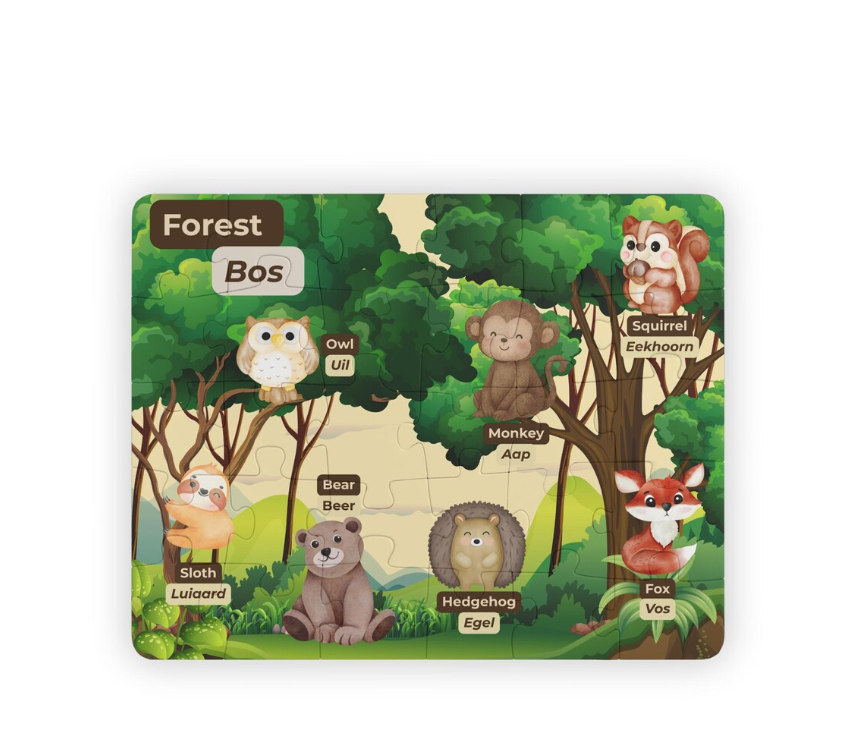
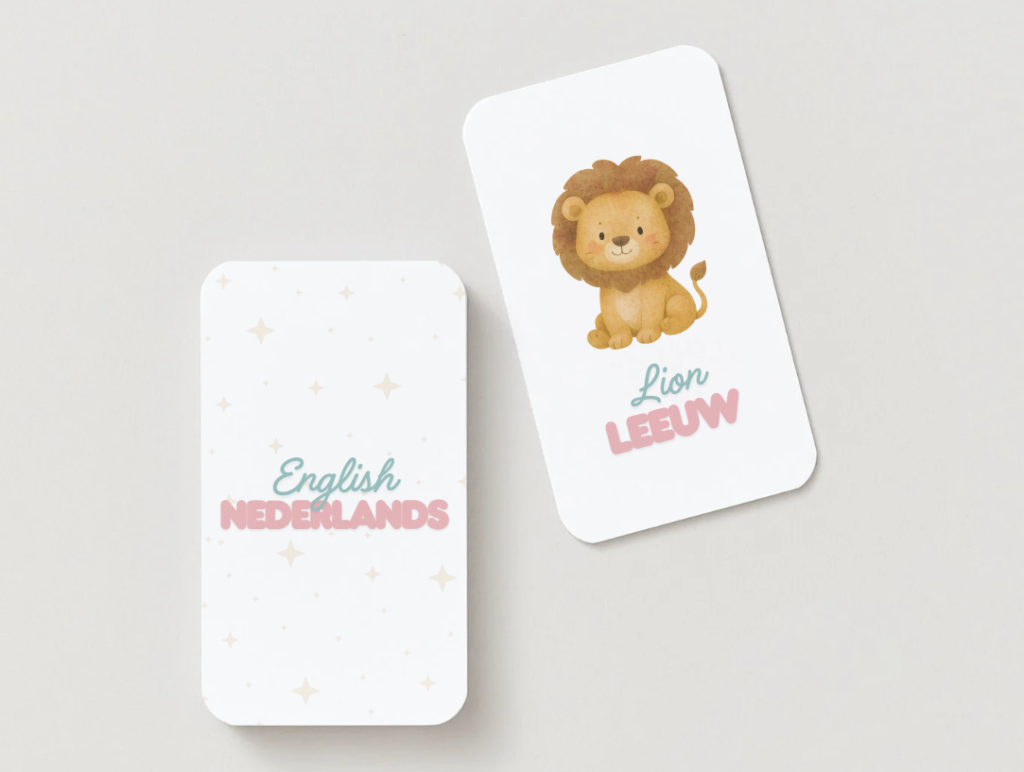
I notice everything works better when it does not feel like “learning.” So we try to add small things in a playful way. I created a few bilingual products that we use together, like a bilingual puzzle we go through together or flashcards with both languages on them.
Not because I think he will suddenly forget Dutch tomorrow. More because I want both languages to exist naturally next to each other. Without pressure. Without making it feel like extra schoolwork.
Tom is 4 now and only in pre kindergarten at daycare. But once he reaches the age of group 3 in the Netherlands, we will probably arrange something extra for Dutch. Maybe a language camp in the Netherlands. Or something that helps him stay on level with reading and grammar too.
Of course you can also structure that throughout the year. But honestly, I already know life will become busy enough. Two full time jobs, school, sports, homework. Yes, even here they somehow manage to give small children homework already.
So we are also trying to stay realistic about what is actually manageable.
Our daughter will grow up very differently
Our daughter was born here in America. Which immediately makes things different. For her, English has always been everywhere. It is not something she had to learn later like Tom did. It is simply part of her world from the beginning. So I already know we will probably have to be much more intentional with Dutch for her.
She is 1.5 now and does not say a huge amount yet. Mostly a mix of Dutch and English words. Apparently it is completely normal for bilingual children to start talking a little later because they are processing two languages at once.
With her, we mainly focus on speaking a lot of Dutch and teaching things playfully. Nothing complicated. Just talking, reading books, singing songs, and hoping some of it sticks somewhere in the middle of daily life chaos.
Whether we can use exactly the same approach with her as we did with Tom? Honestly, I have no idea. Maybe that is also part of raising kids abroad. You are building something while simultaneously figuring it out yourself.